St Michael's CofE Primary School Living and Learning Together
Maths
"Mathematics is the most beautiful and most powerful creation of the human spirit."
Stefan Banach


Intent
At St Michael’s we aim to nurture flexible, brave and excited mathematicians who are curious and feel empowered to tackle new challenges. We follow a mastery approach to maths and this means pupils of all ages acquiring a deep, long-term, secure and adaptable understanding of the subject. The phrase ‘teaching for mastery’ describes the elements of classroom practice and school organisation that combine to give pupils the best chances of mastering maths. Achieving mastery means acquiring a solid enough understanding of the maths that has been taught to enable pupils to move on to more advanced material.
The essence of maths teaching for mastery:
- Maths teaching for mastery rejects the idea that a large proportion of people ‘just can’t do maths’.
- All pupils are encouraged by the belief that by working hard at maths they can succeed.
- Pupils are taught through whole-class interactive teaching, where the focus is on all pupils working together on the same lesson content at the same time, as happens in Shanghai and several other regions that teach maths successfully. This ensures that all can master concepts before moving to the next part of the curriculum sequence, allowing no pupil to be left behind.
- If a pupil fails to grasp a concept or procedure, this is identified quickly and early intervention ensures the pupil is ready to move forward with the whole class.
- Lesson design identifies the new mathematics that is to be taught, the key points, the difficult points and a carefully sequenced journey through the learning. In a typical lesson pupils sit facing the teacher and the teacher leads back and forth interaction, including questioning, short tasks, explanation, demonstration, and discussion.
- Procedural fluency and conceptual understanding are developed in tandem because each supports the development of the other.
- It is recognised that practice is a vital part of learning, but the practice used is intelligent practice that both reinforces pupils’ procedural fluency and develops their conceptual understanding.
- Significant time is spent developing deep knowledge of the key ideas that are needed to underpin future learning. The structure and connections within the mathematics are emphasised, so that pupils develop deep learning that can be sustained.
Key facts such as multiplication tables and addition facts within 10 are learnt to automaticity to avoid cognitive overload in the working memory and enable pupils to focus on new concepts.
Implementation
At our school, we have embraced White Rose as our main resource for designing and implementing our own St Michael's mastery curriculum. White Rose is a resource that has been designed for UK schools based on research and extensive experience of teaching and learning around the world and here in the UK. It has been designed to support and challenge all pupils, and is built on the belief that EVERYONE can learn maths successfully.
Our children begin their mastery maths journey in EYFS and it is here that they engage with Mastering Number as well as our own coverage of shape, space and measure. Mastering Number is a mastery approach to number which begins in EYFS and is continued throughout KS1 and KS2 fluency sessions. It builds fluency in calculation and a confidence and flexibility with number.
We believe that to enable children to access and enjoy more difficult concepts, they must have a secure understanding of key facts such as multiplication tables and addition facts within 10. Therefore, we use Times Table Rock Stars across the Year 2 and KS2. This has provided the learners at our school with a fun and engaging tool that allows them to improve their understanding of number and multiplication.
Impact
The impact of our approach to maths learning at St Michael’s is to create children who have the skills, knowledge and confidence to prepare them for the next stage in their educational journey and beyond. It is important that we give our mathematicians the opportunity to become resilient and to understand what is meant by 'knowing' something and how it can be applied elsewhere. By providing sufficient learning opportunities and links between representations and structures, mathematical reasoning, variation and fluency we aim to ignite a fascination in maths that highlights it’s importance. We want children to recognise that maths goes beyond the classroom and can been seen in all areas of life and future experiences.
At St Michael's, we adapt and enrich our mastery maths to ensure our high quality maths curriculum details the core facts, concepts, methods and strategies that give pupils the best chance of developing proficiency in the subject. To be able to develop this proficiency we nurture the different types of knowledge and aim to have mathematicians that are able to explain what they know, how they use it and when they use it.
Factual Fluency in our school
At St Michael's we understand the importance of fluency and how a strong grasp of number and times table knowledge can support the working memory. Two of the tools we use for practicing our understanding of these areas are Mastering Number in KS1 and KS2 and Time Table Rock Stars in KS2. Below you can find information on both and login information for Times Table Rock Stars.
Mastering Number
Mastering number is taught from reception to year 5 on top of our mastery maths lessons using White Rose. The aim of this is that over time, children will leave KS1 with fluency in calculation and a confidence and flexibility with number. The short lessons focus on key knowledge and understanding for each year group and provide children with opportunities to develop and demonstrate good number sense.
Our Mathematicians and their Knowledge
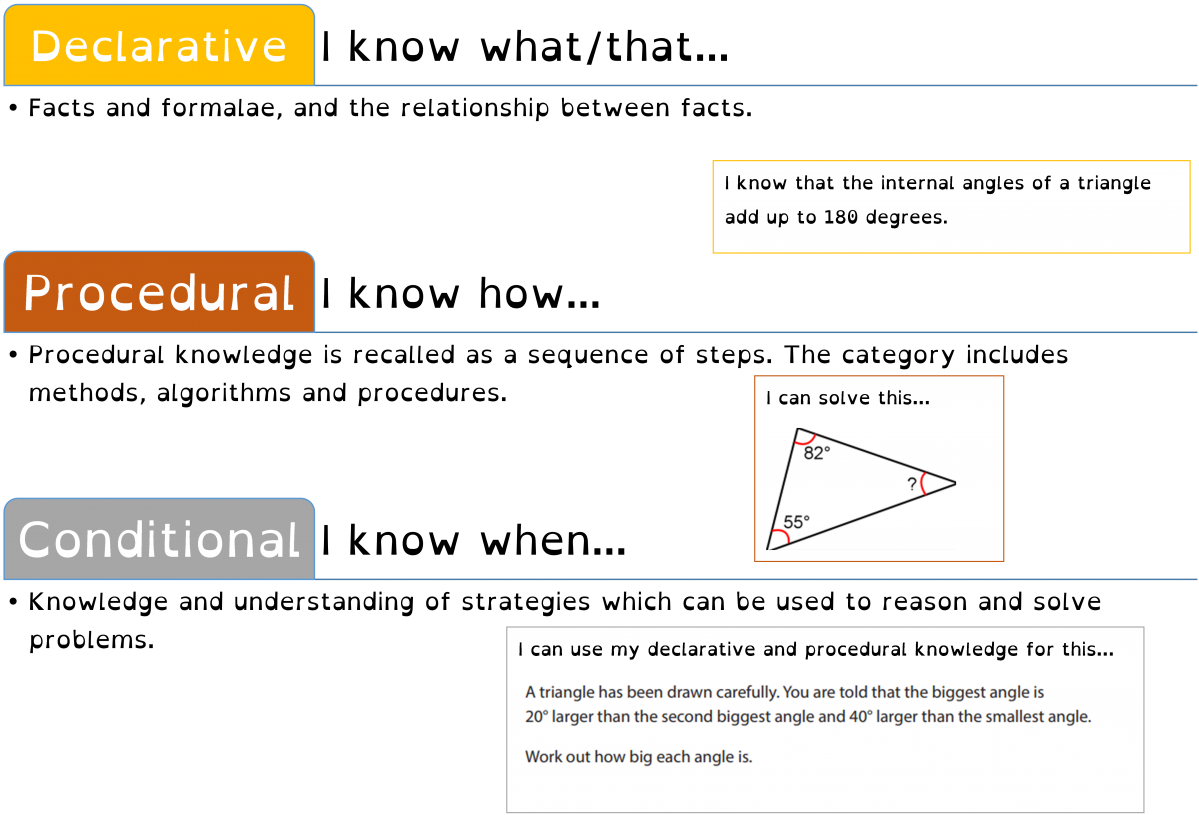
The first misunderstanding is to think that when we speak of knowledge, we only mean acquiring facts. Knowledge can be divided into declarative knowledge, procedural knowledge and conditional knowledge.
- Declarative knowledge is the knowing of this or that, e.g. penguins have feathers or trees grow by converting carbon dioxide and sunlight into oxygen (photosynthesis).
- Procedural knowledge is the knowing how to do things or the steps/strategies involved in how to do things, e.g. the steps involved in multiplying mixed numbers or the best ways to make a tuna sandwich.
- Conditional knowledge involves knowing the when and the why to apply the other two types of knowledge, e.g. readers skim newspapers to get the gist, but apply close reading to literature or difficult texts to develop deeper understandings.